bg Back

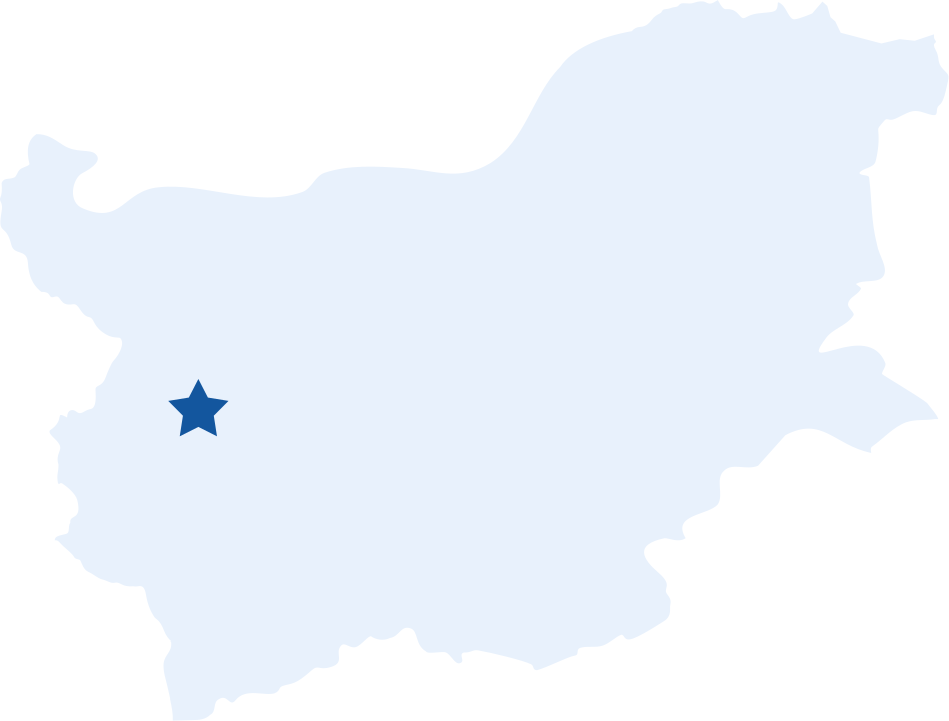
Sofia, Bulgaria EU Cohesion Policy & Structural Funds

How does the EU support regional development and cohesion?

Some parts of Europe are rich and modern, other parts are much poorer. When some regions grow while others fall behind, it creates problems for all of Europe. Regional development and cohesion helps poorer regions catch up with richer ones – leading to development. The goal is to reduce the gaps between different parts of Europe. Not to make everywhere exactly the same, but to make sure that everyone has similar basic opportunities for their work, education and life – this is cohesion. Why should we care about this? When some areas fall behind economically, young people leave for better opportunities (like work) elsewhere. Businesses try not to invest in these areas because it doesn’t make much money. This means that the EU's internal market won't work.

Table of Contents

  1. 01 Key Information
  2. 02 Everyday Example
  3. 03 Good to Know
  4. 04 FAQ
  5. 05 Quiz
  6. 06 Summary

What Does “Cohesion” Actually Mean?

In EU terms, cohesion means bringing regions closer together economically. It also has a means that all citizens can have jobs (that pay enough), education, and social services. This means that geography doesn’t decide your life and everyone in the EU has similar chances.

1 / 3

How It Works

The main way it all works is through what is called financial solidarity. Richer EU countries and regions pay into the EU budget. This money is then used to help poorer regions.

2 / 3

And who gets help?

The EU uses a GDP per capita (the amount of money a country, a region or a city makes in a year, divided by how many people live there). The average is the basis for the decision:

-> Regions with GDP per capita below 75% of the EU average get the most

-> Regions with 75-90% get moderate support. 

-> Richer regions get some funding for specific projects


3 / 3

Everyday Example

Bulgaria’s Transformation

Let us see how this works in practice by looking at Bulgaria since it joined the EU in 2007.

  • Infrastructure transformation: The money enabled the construction of new motorways and connected cities much better. Sofia’s metro got modern and better trains started working. 


  • Digital revolution: High-speed internet also came to small villages. And government services also became more digital and online. This helped start tech companies and digital businesses which now work internationally.

Educational improvements: EU investment modernised university research with more modern tools. It started vocational training with high standards, and helped with international exchange programs for students and teachers.


Good to Know

Even though many years of cohesion policy have passed, there are still big differences between European regions:

  • Education systems and how much innovation and research can be made.
  • Infrastructure and how well local governments work 
  • Geography and history

The Place matters: The EU has learned that one-size-fits-all solutions don’t work. Instead, it now uses a place-based approach, meaning that it focuses on what each region does best. Coasts need to develop industries that are more related to the sea, while mountain areas can focus on sustainable tourism. Bigger cities are often good at specialising in digital services.

FAQ

How is the EU managing the funding?
The EU doesn't just give money directly. Instead, it uses three special offices that manage the money and the funds:
What is the European Regional Development Fund (ERDF)?
The ERDF builds infrastructure, supports innovation, and helps small businesses. It mainly works on actual and digital infrastructure. It pays for major projects. The fund supports small and medium businesses and also spends in green energy projects. It helps to improve internet connections in rural areas.
What is the European Social Fund (ESF)?
The ESF invests in people through education, training, and employment. They spend mostly on job training for unemployed workers to help them find new jobs. The ESF helps education improvements in schools and universities and gives support to young entrepreneurs. It also helps people with disabilities find jobs.
What is the Cohesion Fund (CF)?
The CF works on environment and transport in the poorest EU regions. It works on the biggest infrastructure questions. It builds important water treatment plants that protect public health and the environment. It also pays for national parks and things like flood defences.
How much money is the EU spending?
To understand how big this is: for 2021 to 2027, these funds together, a budget of €392 billion. That is about one-third of the entire EU-budget. This makes the cohesion policy the EU's largest program.

Quiz

What does cohesion policy try to do?

What does the European Regional Development Fund (ERDF) do?

How does the EU decide which regions get the most support?

Summary

  • GDP growth in supported regions is typically 1-3% higher than it would be without EU funding

  • Unemployment falls faster in regions with focused EU investments

  • Business creation and innovation increase in areas with EU support

  • The EU cohesion policy faces new challenges but remains essential to the European project. It shows that even richer countries and regions become stronger when all the regions in the EU can contribute to and benefit from shared prosperity