be Back

Brussels, Belgium Founding Treaties

When Brussels became important and why?

The European Union is one of the most bold political experiments in our time. It started after the Second World War. European leaders had a radical idea: instead of competition with each other, countries should work together. Today, the EU includes 27 countries and over 450 million people. But it started small. A handful of Western European countries created new institutions (similar to ministries). They made treaties that put down the rules on how these institutions work. They also started making Brussels the unofficial capital of Europe. Why did this happen? What did the treaties do? And why did Brussels become so important? Understanding these questions helps us grasp what makes the European Union unique.

Table of Contents

  1. 01 Key Information
  2. 02 Good to Know
  3. 03 FAQ
  4. 04 Today's Challenges
  5. 05 Summary

The Founding Treaties: Building Something New

Paris, 1951: The First Experiment

The first big step was in 1951, with the Treaty of Paris. This created the European Coal and Steel Community (ECSC). But this was much more than a business deal.

Why coal and steel? These industries were essential for making weapons. If countries shared control over them, they couldn’t easily go to war against each other. Six countries joined: France, West Germany, Italy, Belgium, the Netherlands, and Luxembourg.

The ECSC created something completely new – shared institutions. It had:

  • An independent leader 
  • A parliament
  • A way for each countries ministers to meet
  • A court for all members
1 / 3

This was completely new – revolutionary. Countries gave up some of their independence to the shared institutions. It was a test case. Would it work?

Rome, 1957: The Common Market

The ECSC succeeded. So the same six countries decided to do more. In 1957, they signed the Treaties of Rome. They took the ECSC and created two new things: the European Economic Community (EEC) and Euratom.

What made the EEC special? It introduced the four freedoms:

  • Free movement of things (goods)
  • Free movement of work (services)
  • Free movement of money (capital)
  • Free movement of people


The goal was big: create a common market as large as the United States. But the Treaties of Rome included something even more important. They spoke of “ever closer union among the peoples of Europe.” This meant the work to have more and more shared and common things would continue and become more over time – this is what we call the European integration, because it puts single things together. Like work – people were suddenly allowed to work in every country.

The treaties also strengthened how common decisions were made (institutions). They started what would later be today’s European Union.

2 / 3

Later Treaties: Deepening the Union

The story didn’t end there. The European integration continued with more treaties:

The Maastricht Treaty (1992) was a game-changer. It changed the European Community into the European Union. Most importantly, it brought together the economy of each country and created the Euro (€).

The Lisbon Treaty (2007) making decisions got easier. The European Parliament also got more power. It also gave the EU a foreign minister who is called High Representative Foreign Affairs.

Each treaty was because of practical needs and had compromises. The result? An international thing that doesn’t fit traditional ideas. It’s neither a country nor an international organisation (like the UN or the OECD). It’s something unique.

Today, the EU faces a critical challenge: the unanimity rule. For many important decisions – like foreign policy, taxes, or accepting new members – all countries must agree. Only one country can block everything. Some say that this made sense with six countries in 1951 but not with 27. It makes the EU slow and sometimes unable to act.

Some leaders want to change this. They want more votes where decisions pass if enough (not all) countries agree. Others refuse. They say unanimity protects single countries from being overpowered. This debate shows a fundamental democratic question: how do you make decisions faster while also respecting each voice?

3 / 3
Good to Know

Brussels: How a city became Europe’s Capital

The Accidental Capital

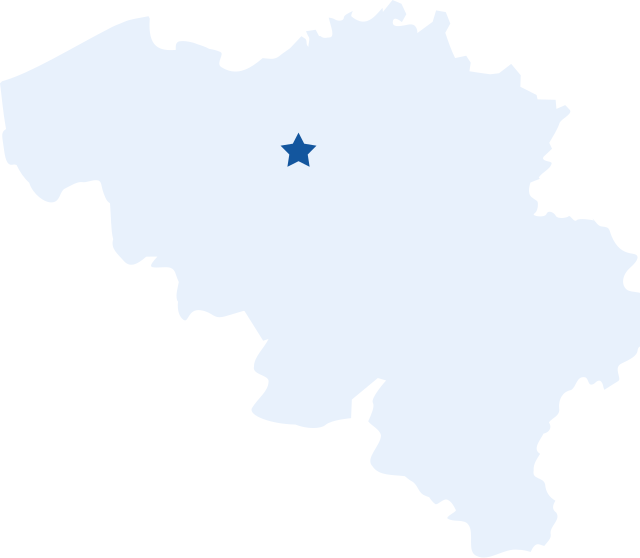
Brussels didn’t become Europe’s capital because of a decision to do that. Unlike Washington or Berlin, no one planned it this way. So how did it happen?

At the beginning, the European offices were in different cities. The ECSC for example started in Luxembourg. But by the late 1950s that was not practical anymore. The countries needed to have all the institutions somewhere together.

But why Brussels? The city had several advantages:

  • Location: It is somewhat in the middle of the original six member countries
  • No Threat: Belgium was small and did not threaten the larger countries by becoming important and powerful
  • Languages: In Brussels people already spoke two languages and other international organisations were there too
  • Infrastructure: It had good transport connections to the other countries

Today, Brussels works like Europe’s capital but it is not an official capital like other countries’ capitals. It has most EU-institutions. Thousands of European civil servants work there. Diplomats from all countries have offices there. Lobbyists and journalists follow European politics from there.

One important note: Strasbourg is still the main base for the European Parliament. But Brussels hosts most parliamentary activities.


FAQ

Why Treaties Matter
The founding treaties tell us something important about European integration. This wasn't one moment where everything was decided. It was a slow process. Each treaty built on the ones before. Each was made because of what was needed at the time and what countries could agree on. The treaties also show how European integration works through law. Unlike other international agreements, EU treaties create rules that countries must follow. They set up institutions with real power. They create rights that normal people can use in court.
How does European integration work?
The people who started the EU had a plan. Start with practical cooperation in one area. This creates reasons for cooperation in other areas. Slowly, this builds habits of working together. Eventually, it creates a feeling of working for a common goal. This approach had good points: It avoided big political vows that could fail It built trust through practical success – “it worked” It helped people to have reasons for supporting more integration It made working together and cooperation normal instead of special
The Brussels Model
Brussels represents a different way of thinking about capital cities. It wasn't forced from above. It came from practical needs. It shows compromise rather than one country overpowering others. This is similar to how European integration normally works. It's practical and slow rather than revolutionary. It respects national cultures and differences but also creates shared things like how decisions are made.

Today's Challenges and Questions

The European project still faces ongoing challenges.

What are the main debates today?

  • How much independence should countries give up to EU institutions?
  • How can the EU stay democratic as it grows larger and more complex?
  • How should the EU balance unity with diversity?
  • What role should the EU play in the world?


These questions don’t have easy answers. But they show that European integration is still a work in progress. The founding treaties provided the first steps but each generation must decide where to go next.

Summary

  • The European Union didn't start in a single moment. It was treaties and treaties on top of each other and lots of negotiations. The EU-institutions reflect both the vision of integration and the realities of compromise.

  • Brussels became Europe's capital in the same way. Not by design but by default. Through practical events and decisions.

  • Together, the founding treaties and Brussels show us something important. European integration has developed carefully and like an experiment. This has of course strengths and weaknesses. It can seem slow and complicated (bureaucratic). But it has also achieved something unique: making former enemies into partners. It has created the world's largest economy and created peace for more than 70 years.